Browsers · platforms · coordination · networks
Trace browser, platform and protocol behavior end to end
Browsers, developer platforms, consensus, deployment and network behavior. Follow a guided path from first principles to the behavior that matters in production.
Choose a path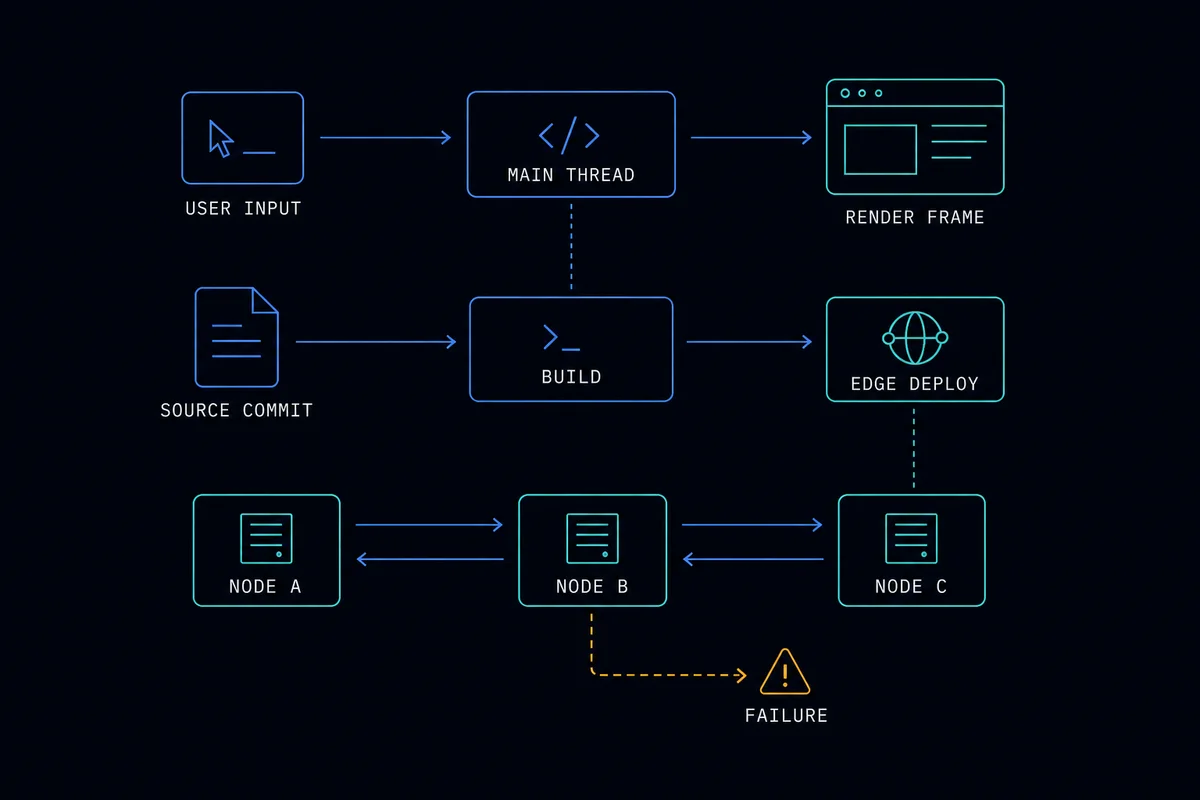
01 / Pick where to begin
Choose a learning path
8 guides across 3 paths01 / Input · rendering · responsiveness
Browser path
0 of 2 runs completeWhere does browser INP get stuck in the rendering pipeline?
How bytes become pixels through the rendering pipeline and where exactly INP pressure shows up when the main thread gets stuck.
How do you solve centre-of-mass and collision problems without losing the signs?
A Class 11 mechanics path from mass-weighted position and centre-of-mass motion through signed momentum, restitution, elastic and inelastic collisions, and a checked two-dimensional solving workflow.
02 / Build · deploy · edge
Platform path
0 of 3 runs completeHow do you go from zero to a useful Clanker workflow?
The actual path from zero to useful with Clanker: install, config, first grounded question and then maker plans that talk to real backends.
How does Netlify turn one deploy into a globally served site?
How one git push becomes a globally served site through immutable deploys, edge POPs and instant rollback that just works.
What is Git saying when you pull?
Replay a real git pull between Carol’s laptop and a server: how they find the history they share, which objects travel, how deltas shrink them, and why the fetch alone changes none of her files.
03 / Consensus · control planes · failure
Coordination
0 of 3 runs completeHow does Raft keep quorum alive when the leader goes down?
How silence becomes an election, why majority replication is the commit rule and what happens to a stale leader after failover.
How does Cursor Origin keep Git fast, durable, and consistent?
A source-backed tour of Continuity, the Git storage system beneath Cursor Origin, from packfile locality and WAL publication through CAS races, verified reads, shared compaction and elastic replicas.
Why does a slow server attract more work?
Follow request IDs through worker queues and connection return histories. Change reuse order and watch the same traffic recover in a model inspired by OpenAI Habitat.
About this collection
A web interaction crosses more layers than its interface suggests. Browser work competes on the main thread, platform services turn source changes into deployed artifacts and coordination protocols keep independent nodes moving toward a shared result. Performance and reliability problems often appear at one layer while their cause lives in another. Seeing the sequence end to end is the quickest way to replace vague assumptions with a testable model.
Start with browser rendering and Interaction to Next Paint to understand how input becomes a visible frame. The rest of the collection follows deployment platforms, cloud control paths and coordination mechanisms such as Raft. These guides are aimed at engineers who need to debug a slow interaction, reason about a managed platform or understand why a protocol takes a particular path during failure. They focus on the handoffs between components, the state each component owns and the evidence that distinguishes one failure mode from another.